
Aesthetic Medicine
Enhancing Beauty With Confidence

Dr. Diogo Guimarães
Plastic Surgeon
Medical License Number: 62522

Drª. Fátima Rodrigues
Medical License Number: 48891

Drª. Joanna Goldamann
Medical License Number: 40586

Dr. THomas Kaiser
Medical License Number: 40189

Dr. Carlos Maldonado
Medical License Number: 52335

Drª. Daniela Silva
Medical License Number: 71638

Drª. Fabiola Murta
Oculoplastic Surgery Specialist
Medical License Number: 69477
Aesthetic Medicine
Aesthetic Medicine is a medical field dedicated to the prevention and treatment of ageing signs, improvement of skin quality and facial and body harmonisation through personalised and minimally invasive approaches.
The goal of Aesthetic Medicine is to achieve natural, balanced and progressive results while respecting each person’s identity, facial expression and individual characteristics.
Enhancing Beauty With Confidence
At Family Medical Centre & Antiaging Clinic, Aesthetic Medicine is based on an integrated and personalised medical approach focused on health, wellbeing, self-confidence and healthy ageing.
Each treatment plan is defined following a detailed clinical assessment, allowing protocols to be tailored to each patient’s needs, goals and characteristics.
What does Aesthetic Medicine include?
Aesthetic Medicine integrates different treatments and approaches focused on prevention, rejuvenation and improvement of skin quality.
Facial Rejuvenation
Treatments focused on softening signs of ageing, improving firmness and revitalising the skin.
Facial Harmonisation
Personalised approaches focused on enhancing and balancing facial features naturally.
Skin Quality & Texture
Protocols focused on skin luminosity, hydration, elasticity and overall skin improvement.
Skin Laxity & Collagen Stimulation
Treatments designed to improve skin firmness and stimulate tissue regeneration.
Pigmentation & Photoageing
Assessment and treatment of pigmentation changes and skin damage associated with sun exposure and ageing.
Preventive Aesthetic Medicine
Strategies focused on early prevention of ageing signs and long-term skin health maintenance.
Facial & Body Contouring
Minimally invasive treatments focused on improving facial and body contours.
Advanced technology and treatment approaches
At Family Medical Centre & Antiaging Clinic, we use advanced Aesthetic Medicine techniques and technologies, prioritising safety, natural results and personalised treatments.
Protocols may integrate different therapeutic approaches, including:
Biostimulation and skin regeneration
Radiofrequency and tissue remodelling technologiesMinimally invasive injectable treatments
Facial and body rejuvenation protocols
Combined therapies tailored to individual needs
A natural and personalised approach
Modern Aesthetic Medicine focuses on elegant, discreet and natural-looking results that enhance individual beauty rather than changing personal identity.
Personalised assessment allows the definition of strategies adapted to age, skin characteristics, aesthetic goals and lifestyle.
Beauty, confidence and wellbeing
Improving appearance and skin quality may have a positive impact on self-esteem, confidence and overall wellbeing.
At Family Medical Centre & Antiaging Clinic, we are committed to a close, specialised and personalised medical approach focused on natural results, safety, healthy ageing prevention and the promotion of health and wellbeing.
Personalised care to improve skin firmness, texture and evenness.
Loss of firmness, wrinkles, pigmentation and small visible blood vessels can affect the appearance of the skin on the face and body. Each concern has its own characteristics and benefits from a tailored approach.
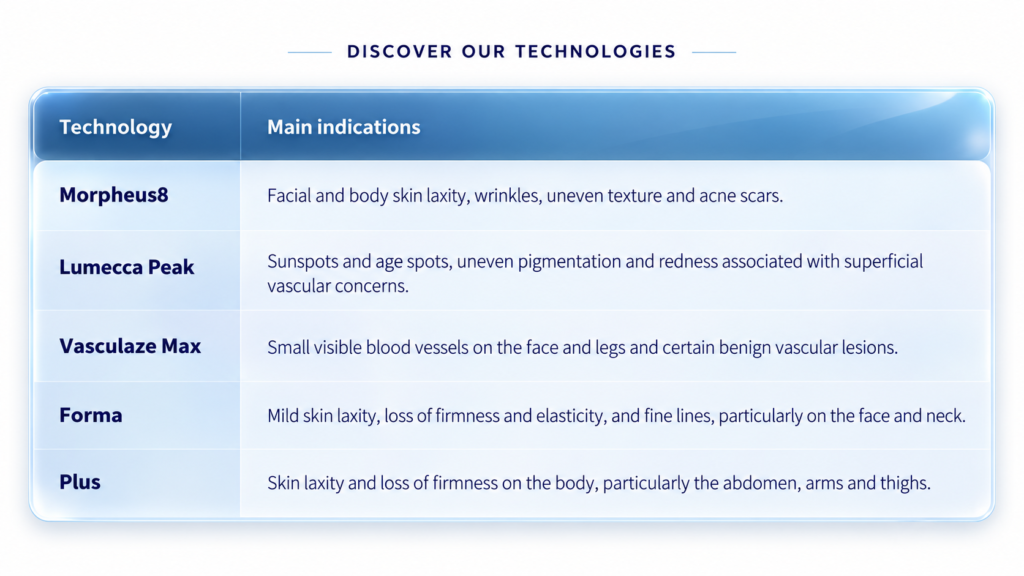
At Family Medical Centre & Antiaging Clinic, we offer different technologies to address these needs: Morpheus8, Lumecca Peak, Vasculaze Max, Forma and Plus.
These treatments use radiofrequency, intense pulsed light or laser energy, each working in a different way. They allow us to develop treatment plans focused on skin quality, facial and body rejuvenation, and selected pigmentation and vascular concerns.
A treatment plan built around your skin
An aesthetic medicine consultation is the first step. Your assessment considers your goals, skin characteristics, medical history and previous treatments.
This information helps determine the most appropriate technology, treatment schedule and aftercare. Where suitable, different approaches may be incorporated into a personalised plan.
Book your aesthetic medicine assessment consultation.
Radiofrequency microneedling for facial and body rejuvenation
Morpheus8 is a minimally invasive treatment that combines microneedling with fractional radiofrequency. It works at different depths of the skin, promoting tissue remodelling and improvements in firmness and texture.
What are the main indications?
Skin laxity on the face and body.
Wrinkles and fine lines.
Uneven skin texture.
Acne scars, in selected cases.
How does it work?
Microneedles deliver radiofrequency energy at controlled depths. This mechanical and thermal action stimulates the skin’s repair and remodelling response, including collagen production.
Treatment depth and energy are adjusted according to the area, tissue characteristics and treatment goals.
Morpheus8 Burst and Burst Deep
Morpheus8 Burst can be used on the face and smaller body areas, delivering energy at different depths.
Morpheus8 Burst Deep is designed for larger body areas, such as the abdomen, arms and thighs, allowing treatment to be adapted to skin laxity and the characteristics of each area.
What happens during a session?
Treatment takes place in a clinical setting. A topical anaesthetic cream may be used to reduce discomfort, depending on the medical assessment. Session length varies according to the size of the area and the treatment protocol.
When will I see results, and how many sessions are needed?
Improvement is gradual and may develop over the following weeks and months as tissue remodelling takes place.
Several sessions may be needed. Their number, spacing and any maintenance treatments are determined individually, according to the response.
What is recovery like?
Redness, swelling, sensitivity and small scabs may occur. Their intensity and duration depend on the treatment area and settings.
Aftercare includes gentle cleansing, moisturising and sun protection, following the clinical team’s instructions. Returning to make-up and your usual routine should take account of your skin’s recovery.
What risks should be considered?
Radiofrequency microneedling can cause complications, including burns, pigmentation changes, infection, scarring and unwanted fat loss. Nerve injuries have also been reported. Treatment selection and discussion of individual risks form part of the medical consultation.
Book your aesthetic medicine assessment consultation.

Intense pulsed light for pigmentation, redness and a more even complexion
Lumecca Peak uses intense pulsed light — IPL — to treat selected pigmentation concerns and small superficial blood vessels. The aim is to improve skin tone evenness and overall appearance.
What are the main indications?
Sunspots and age spots.
Uneven pigmentation associated with sun exposure.
Small superficial blood vessels.
Redness associated with rosacea, in selected cases.
Signs of photoageing.
How does it work?
Light energy is absorbed by pigment and blood components within the targeted structures. This allows selective treatment of certain pigmented and vascular concerns.
Treatment is adjusted to the type of lesion and skin characteristics, with the aim of improving skin appearance and evenness.
Which areas are commonly treated?
The face, neck, décolletage, hands and arms are frequently treated, particularly where changes are associated with sun exposure.
What happens during a session?
Pulses of light are delivered to the skin. You may feel warmth and a brief snapping sensation. The cooling system helps reduce discomfort.
When will I see results, and how many sessions are needed?
Improvement develops as the pigmented and vascular concerns respond to treatment. Some people notice changes after one session, while others require a course of treatments.
The number and spacing of sessions depend on the type and extent of the concern, skin phototype and treatment response.
What can happen after treatment?
Redness, warmth or mild swelling may occur. Some pigmented spots may temporarily darken before flaking and becoming less visible.
Sun protection and the aftercare recommended by the clinical team are important.
Is it suitable for every skin type or pigmented lesion?
Suitability requires a medical assessment. Skin phototype, recent tanning and the nature of the lesion influence treatment selection.
Possible risks include pigmentation changes, blistering and scarring. These factors are considered during the assessment and discussed before treatment.
Book your aesthetic medicine assessment consultation.

Targeted laser treatment for small blood vessels and vascular lesions
Vasculaze Max is a laser technology designed to treat selected visible blood vessels and benign vascular lesions. It works locally to reduce vessel visibility and improve the appearance of the skin.
What are the main indications?
Small visible blood vessels on the face.
Small blood vessels on the legs.Telangiectasias, often known as thread veins or spider veins.
Certain benign vascular lesions, such as angiomas.
How does it work?
Laser energy is directed at the blood vessels identified during the assessment. Its thermal action treats the selected vessel, which may gradually become less visible.
The applicator allows a precise approach, with surface cooling during treatment.
Which areas can be treated?
The face and legs are among the most commonly treated areas. Other locations may be considered depending on the type of lesion and the medical assessment.
What happens during a session?
The team identifies the vessels to be treated and adjusts the settings according to their size, location and characteristics.
You may feel warmth or brief stinging sensations during treatment. Session length depends on the number of vessels and the size of the area.
When will I see results, and how many sessions are needed?
Vessels may gradually become less visible after treatment. Some lesions require several sessions.
The treatment plan depends on the type, size and depth of the vessels and the response observed.
What is recovery like?
Localised redness, sensitivity or swelling may occur. The clinical team will advise on sun exposure, heat and physical activity according to the treated area.
Is it suitable for every vascular concern?
The assessment distinguishes small superficial vessels from conditions requiring a different approach. Larger varicose veins require a specific vascular assessment and are not a usual indication for this treatment.
Book your aesthetic medicine assessment consultation.

Non-invasive radiofrequency for facial skin firmness
Forma uses bipolar radiofrequency to improve skin firmness, elasticity and quality. It is a non-invasive approach, particularly suited to areas such as the face and neck.
What are the main indications?
Mild skin laxity.
Loss of firmness and elasticity.
Fine lines.
Changes in skin texture.
How does it work?
Radiofrequency produces controlled tissue heating, stimulating collagen production and skin remodelling.
The system monitors temperature during treatment, allowing energy delivery to be adjusted and heating to remain within the selected parameters.
Which areas are commonly treated?
The face, jawline and neck are among the areas that may be considered following a clinical assessment.
What happens during a session?
The applicator is used on the skin’s surface, without microneedles. You will feel gradual warming, with its intensity monitored by the team.
Session length varies according to the area and the chosen protocol.
When will I see results, and how many sessions are needed?
The aim is a gradual improvement in firmness and texture. Treatment is usually organised as a course of sessions, with the response reassessed throughout the plan.
The need for maintenance depends on skin characteristics, progress and individual goals.
What is recovery like?
Returning to your usual routine is generally quick. Temporary redness or warmth may occur.
Aftercare is tailored to the skin’s response. Although non-invasive, treatment is not risk-free: burns or pigmentation changes can occur and should be discussed during the medical assessment.
How do I know whether it is suitable for me?
The consultation assesses the degree of skin laxity, skin quality and expectations. The team explains what improvement may reasonably be expected and determines the most appropriate plan.
Book your aesthetic medicine assessment consultation.
Non-invasive radiofrequency for body skin firmness
Plus is a bipolar radiofrequency technology developed for larger areas of the body. Treatment aims to improve skin firmness and elasticity, with an approach tailored to the laxity of each area.
What are the main indications?
Body skin laxity.
Loss of firmness and elasticity.
Changes in skin quality and texture associated with laxity.
How does it work?
The applicator delivers radiofrequency energy through the skin’s surface, producing controlled tissue heating.
This thermal action stimulates collagen production and may contribute to firmer, smoother skin. The system monitors temperature during the session to guide treatment delivery.
Which areas are commonly treated?
The abdomen, arms and thighs are among the most frequently treated areas. Other locations may be assessed according to individual needs.
What happens during a session?
The applicator is used on the skin of the selected area. You will feel warmth, which is monitored and adjusted by the clinical team.
Session length depends on the size and number of areas being treated.
When will I see results, and how many sessions are needed?
Improvement is gradual and follows the tissues’ response to treatment. A course of sessions may be recommended, with intervals and reassessments determined by the team.
Any maintenance treatment is tailored to changes in the skin and each person’s goals.
What is recovery like?
Returning to your usual activities is generally quick. Temporary redness and warmth may occur.
Aftercare is determined according to the skin’s response. Risks, including possible burns and pigmentation changes, are discussed during the consultation.
What should be assessed before treatment?
The consultation distinguishes skin laxity from other body contour concerns and establishes realistic expectations. Plus focuses on skin quality and firmness; it is not a weight-loss treatment.
Book your aesthetic medicine assessment consultation.
FRACTIONAL CO₂ LASER
Wrinkles, scars and skin renewal
Fractional CO₂ laser is a skin resurfacing treatment that can improve wrinkles, selected scars and uneven texture. It treats small areas of skin, encouraging tissue repair and collagen remodelling.
What are the main indications?
Wrinkles and fine lines.
Acne scars and other selected scars.
Uneven texture and signs of sun damage.
The aim is to improve skin appearance and soften existing changes, without guaranteeing the complete removal of wrinkles or scars.
How does it work?
The laser creates small treatment columns, leaving areas of skin between them untreated. This fractional approach triggers a process of healing and skin renewal.
What happens during a session?
Following a skin assessment, the doctor selects the treatment area and intensity. Topical anaesthesia or another form of discomfort management may be used, depending on the extent and depth of treatment.
When will results appear, and how many sessions are needed?
Improvements become more apparent after healing and may continue to develop over the following months. The plan may involve one or several sessions, depending on the indication and individual response.
What is recovery like?
Redness, swelling, peeling and small crusts are expected. Recovery depends on treatment intensity and may require several days of aftercare; redness can persist for longer.
Following the prescribed cleansing, moisturising and sun protection routine is essential. Risks include infection, pigmentation changes and, less commonly, scarring.
Book your aesthetic medicine consultation.
BOTULINUM TOXIN
Softening expression lines
Botulinum toxin is used to temporarily reduce the activity of selected muscles responsible for expression lines. Treatment is planned according to facial anatomy and movement.
What are the main indications?
Horizontal forehead lines.
Frown lines between the eyebrows.
Lines around the outer corners of the eyes, known as crow’s feet.
The treatment areas depend on the medical assessment and the indications of the medicine used.
How does it work, and what happens during a session?
The doctor administers small amounts of the medicine at specific points using a fine needle. Temporarily reducing muscle contraction helps soften lines associated with facial movement.
The aim is to achieve a balanced result that respects each person’s facial features and expression.
When will results appear, and how long do they last?
The effect develops over the first few days and is often noticeable within three to seven days. Results usually last around three to four months, although this varies.
The need for repeat treatment is assessed according to progress and individual response.
What is recovery like?
Most everyday activities can usually be resumed on the same day, following the doctor’s aftercare instructions.
Minor bruising, tenderness or redness may occur. Less commonly, treatment may cause asymmetry or temporary drooping of the eyelid or eyebrow. The initial assessment provides an opportunity to discuss risks, contraindications and expectations.
Book your aesthetic medicine consultation.
HYALURONIC ACID FILLERS
Facial volume and contour
Hyaluronic acid fillers can restore volume, soften selected folds and improve the definition of facial features. Treatment is tailored to each person’s facial proportions and goals.
What are the main indications?
- Loss of volume in the cheeks.
- Selected facial folds and creases.
- Lip definition or volume enhancement.
- Improved chin and jawline definition.
Suitability for each area depends on the product and medical assessment.
How does it work?
Hyaluronic acid is a substance naturally present in the body. In fillers, it is used as a gel with specific properties for different treatment goals and depths of placement.
What happens during a session?
Following a facial assessment, the product is placed at selected points using a needle or cannula. Local anaesthetic techniques may be used to improve comfort.
When will results appear, and how long do they last?
The change in volume is usually visible immediately, but the result should be assessed after the initial swelling has settled.
The effects are temporary. Duration depends on the product, treatment area and individual characteristics.
What is recovery like?
Swelling, bruising and tenderness may occur. Nodules or inflammatory reactions are also possible.
Rarely, blockage of a blood vessel can cause serious complications, including tissue damage and visual impairment. Severe pain, unusual changes in skin colour or visual symptoms after treatment require immediate medical assessment.
Book your aesthetic medicine consultation.
COLLAGEN BIOSTIMULATORS
Collagen stimulation and improved firmness
Collagen biostimulators are injectable products used to stimulate collagen production and progressively improve tissue support. Depending on the formulation, they may also help restore volume.
What are the main indications?
Loss of firmness and tissue support.
Mild to moderate skin laxity in selected cases.
Age-related changes in facial contour.
Volume loss, when this is also an intended use of the chosen product.
How do they work?
Different substances are available, including poly-L-lactic acid and calcium hydroxylapatite. Their mechanisms, indications and application techniques differ.
The choice depends on skin quality, the treatment area and whether the main goal is improved firmness, volume restoration or a combination of both.
What happens during a session?
The doctor administers the product using a needle or cannula at the appropriate areas and depths. Treatment may involve the face and, depending on the product and indication, other regions.
When will results appear, and how many sessions are needed?
Collagen stimulation develops progressively over weeks to months. Some products may also provide an initial change in volume.
The number of sessions and maintenance requirements depend on the substance used and individual response. The expected duration should be discussed for the selected product.
What is recovery like?
Swelling, bruising or tenderness may occur. Risks include nodules, inflammation and, rarely, vascular complications.
Aftercare, including any massage, should follow the doctor’s product-specific instructions.
Book your aesthetic medicine consultation.
SKINBOOSTERS
Skin hydration with hyaluronic acid
Hyaluronic acid skinboosters are injectable treatments designed to improve skin hydration and quality. They can help create a smoother texture and improve elasticity.
What are the main indications?
Dehydrated skin.
Rough or uneven texture.
Fine lines associated with dehydration.
Reduced elasticity and radiance.
The main aim is to improve skin quality without seeking a significant change in facial volume or contours.
How do they work?
Small amounts of hyaluronic acid are placed within the skin, helping it attract and retain water. The product’s properties determine the appropriate treatment depth and areas.
Which areas can be treated?
The face is a common treatment area. Some products can also be used in other areas, such as the hands, according to their specific indications.
What happens during a session?
Following an assessment, the doctor administers small injections in the selected areas. Methods to reduce discomfort may be used.
When will results appear, and how many sessions are needed?
Improvement develops progressively. An initial course of sessions followed by maintenance may be proposed, depending on the product, skin condition and response.
What is recovery like?
Small raised areas at the injection sites, redness, swelling or bruising may occur. Less frequent risks include infection, nodules and vascular complications.
The medical team will explain the appropriate aftercare and follow-up.
Book your aesthetic medicine consultation.
PLATELET-RICH PLASMA — PRP
Skin quality using components of your own blood
Platelet-rich plasma, or PRP, is prepared from a sample of the person’s own blood. It contains a concentration of platelets, which release factors involved in tissue repair.
When might it be considered?
PRP has been studied for improving fine lines, texture and other signs of skin ageing. However, evidence for facial rejuvenation remains limited and results are inconsistent.
It may also form part of selected treatment plans alongside microneedling, including for certain acne scars.
How does it work, and what happens during a session?
A blood sample is collected and processed by centrifugation to prepare the platelet-rich fraction.
Application follows the protocol selected by the doctor and may involve small injections into the chosen areas.
When will results appear, and how many sessions are needed?
When improvement occurs, it tends to develop gradually. There is no universal session protocol for facial rejuvenation.
The response should be reassessed during follow-up. Clinical studies report variable findings, including situations where no meaningful additional benefit was demonstrated.
What is recovery like?
Redness, swelling, tenderness or bruising may occur. Using the person’s own blood does not eliminate procedural risks, including those associated with collection, preparation and application, such as infection.
A medical assessment helps determine suitability and establish realistic expectations.
Book your aesthetic medicine consultation.
EXOSOME TREATMENT
Skin revitalisation and quality
Exosome treatment uses formulations developed to improve skin hydration, radiance and overall quality. It can form part of a personalised rejuvenation plan tailored to each person’s needs.
What are the main goals?Improve the appearance of dehydrated, dull skin.
Soften the appearance of fine lines and uneven texture.
Improve the appearance of skin firmness and elasticity.
Care for skin showing signs of ageing and sun exposure.
How does it work?
Exosomes are small vesicles involved in communication between cells, carrying biologically active molecules.
The formulations combine these components with other ingredients, such as growth factors and hyaluronic acid, with the aim of supporting skin renewal processes and improving hydration.
What happens during a session?
Following a skin assessment, the doctor selects an appropriate protocol. Application may form part of a microneedling session, according to the formulation’s intended use and the characteristics of the treatment area.
The procedure and measures to improve comfort are explained before treatment.
When will results appear, and how many sessions are needed?
Changes in hydration, radiance and texture are assessed over the weeks following treatment.
The number of sessions, intervals between applications and maintenance requirements are determined individually. Response depends on the initial skin condition, the treatment protocol and aftercare.
What is recovery like?
When combined with microneedling, temporary redness, sensitivity and mild swelling may occur.
It is important to follow the advice on moisturising, sun protection and the use of skincare products after the procedure. The medical team will explain the appropriate aftercare, risks and follow-up.
Book your aesthetic medicine consultation.
